
When my mother was diagnosed with Alzheimer’s, my sisters and I cornered the doctor with a litany of questions:
- Are there any medications she can take to improve her memory?
- What about vitamins?
- Should we do more word games with her?
- What about looking at old family photos to jolt memories?
The doctor held up his hand and said, “Sure. We can look into some of these, but if you really want to help your mom, you need to encourage her to exercise more. It’s the best possible treatment.” His words got me thinking about our ESL students. While they don’t have my mother’s disease, they share some of the same feelings, including anxiety, disorientation, insecurity, loneliness, and fear. And, like my mother, their surroundings are unfamiliar and they don’t have immediate access to the words, expressions, and culture clues of those around them. Doesn’t it make sense, then, that physical activity is just as important for second-language students as it is for those with dementia?
Countless studies have shown the importance of exercise for our physical and mental health, but an increasing number of studies show just how important it is to language learners. As we know, learning a new language can cause a torrent of conflicting emotions that hamper students’ ability to process, express, and interpret naturally, without the lenses of anxiety and fear. As such, researchers Akram and Oteir (2025) published a study in BMC Psychology that compared the effects of exercise on the emotional regulation of L1 and L2 students. The study showed that while physical activity benefitted both groups, the second-language learners were able to reduce ES (expressive suppression) considerably more: “A significant interaction effect was observed in students’ ES, with L2 students experiencing more reduction compared to their L1 counterparts, highlighting the unique emotional challenges faced by L2 learners and the effectiveness of physical activity in mitigating these challenges.” This direct and positive rapport between exercise and L2 emotional regulation is noteworthy.
Joshua Cohen, an ESL teacher in Australia, has been using exercise in his classes for several years and has seen the benefits firsthand. In his 2023 article for English Australia, he talks about how physical activity releases a host of neurotransmitters that modulate students’ moods and emotions to better prepare them for learning. Further, he explains how it promotes brain-derived neurotrophic factor (BDNF), which works to modulate synaptic plasticity and, in turn, influences learning and memory. He cites John Ratey, a Harvard neuropsychiatrist, who celebrates BDNF as a “brain fertilizer.” Further, a study conducted by Liu et al. (2017) found that students who exercised while learning vocabulary and sentence formations performed better than those who remained still, and the advantages to these students were long-lasting.
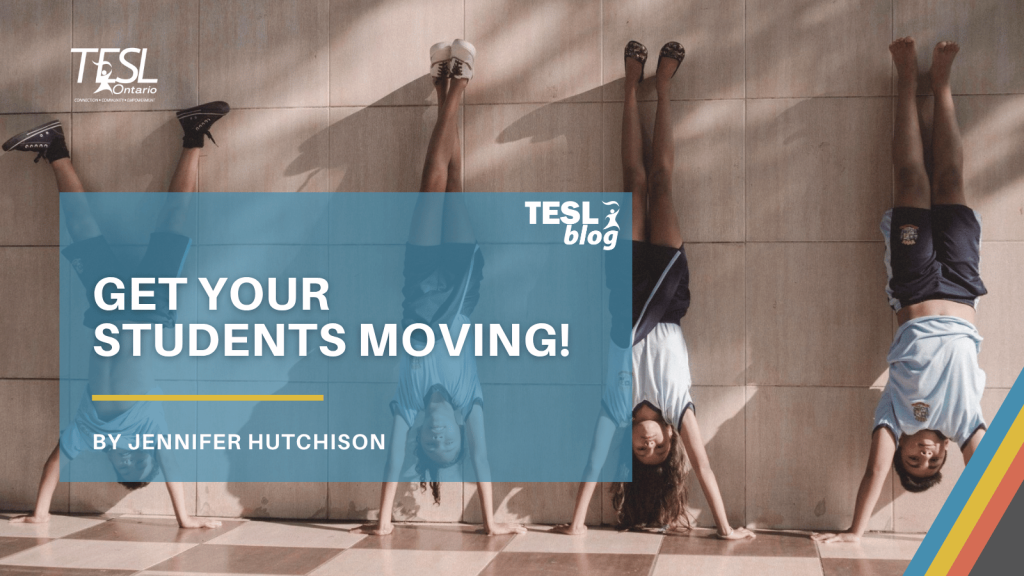
As a college teacher, I know that I can’t send my students to the gym for a quick workout during class. Nevertheless, I can make them move more. I heard an instructor say recently that technology has replaced the old-school standbys such as running dictation. Hmmm. Does it have to? Do we really have to choose digital over physical all the time? Activities like running dictation are a perfect way to get the students learning while moving. You can also have them clear a spot in the middle of the room to do mix-and-mingle activities, perform skits, demonstrate vocabulary, or act out sentences. You can even stop the class at various intervals to run (or walk) on the spot. It’s important to cater to the fitness levels and physical abilities of your students and to explain to them how these activities will help their learning. You can even show them the research that supports it. For more ideas, see the above-mentioned article by Cohen.
We’ve reached an age where students are increasingly drawn to their screens, including fresh air and exercise. It’s time to get them moving again. I, for one, am going to unabashedly go back to the good ole running dictation and maybe a dose of Total Physical Response (TPR) and other tried-and-true ways of getting our students energized and receptive to learning. And maybe, just maybe, I’ll energize myself at the same time. 🙂

Leave a Comment
Your email address will not be published. Required fields are marked *