
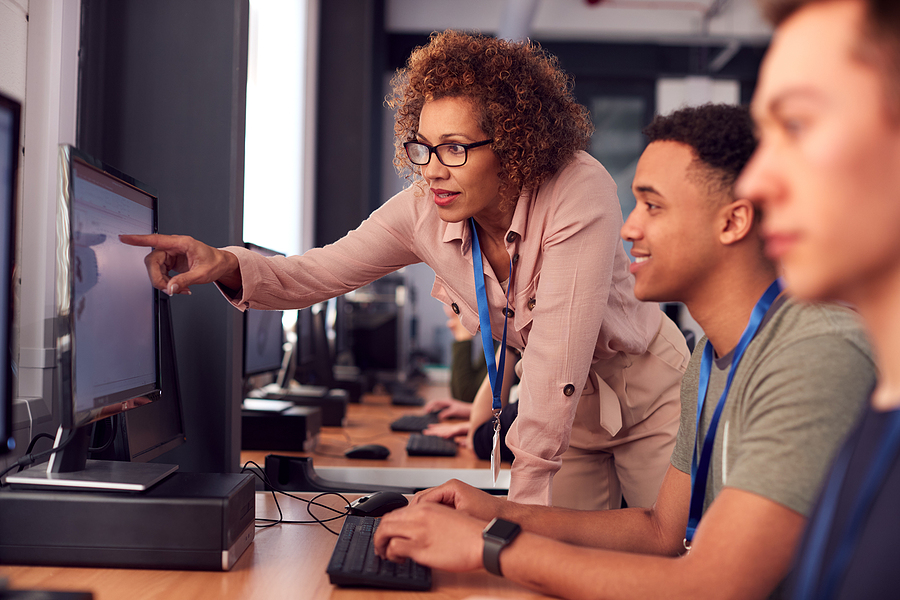
Technology is so embedded in our daily lives that we hardly notice, even take for granted, that we can’t get through our day without our phones, the internet, automated check-outs, Zoom. Yet, when it comes to using computers in the classroom, most teachers are reactionary in their response.
The school where I work will be using Avenue as the main delivery platform for all levels starting in September. This decision, when it was announced last year, did not, and indeed, has not, gone over well with the teachers, to put it mildly.
Adopt a Both/And Mindset
I think what’s underlying teachers’ resistance is that we feel the prioritizing of computers in our lessons challenges the idealism of education. This idealism affirms the human factor that fosters the connection between a teacher and her student over facts and efficiency. After all, there’s more going on in a classroom than the actual lesson itself. The actual lesson delivery system isn’t a computer program, it’s a person – the teacher. Education is a human activity.
This isn’t to say that computers don’t have a place in our classrooms. They do, of course. What I find is that when teachers examine their anxiety and skepticism, and fear too, they find that what’s undergirding their resistance is the zero-sum thinking of an either/or mindset. You can have one, but not the other.
Instead, let’s foster a both/and mindset. Mutual, peaceful co-existence. A symbiotic relationship between teachers and technology. In the case of my school, using computers in our lessons is now mandatory, so teachers have to learn to with work the various programs, not just the required Avenue.
Using computers doesn’t mean having the students on their computers for the entire lesson. That certainly won’t work. Students can only take so much screen time. Then there’s the health risk. This past year, when I’ve had students on computers for the bulk of the lesson, I’ve seen them have to get up to move their legs, stretch their backs, and give their eyes a break.
Some Helpful Tips
Here are a few strategies I used last year to help me maintain diplomatic relations with the machines.
- Have students get up a move around for a kind of body break. I’ve done ball tosses if they’re studying vocabulary and Find Someone Who is fun. Getting the students moving is also a great way of incorporating kinesthetic learning into your lessons.
- Use hand-outs. Hand-outs of the computer activities work well, and aid in reinforcing what the students have been learning digitally.
- Use the whiteboard. Project computer activities on the whiteboard and have the students come up and fill-in the answers. It’s a great way to review and reinforce the digital material and incorporate kinesthetic learning.
Computers Are Our Friends
These are some general tips. Computers work best with the higher levels, but this isn’t to say that you shouldn’t use computers with Literacy and CLB 1. There are challenges specific to those levels when it comes to computers, and lower level students will require more hands-on assistance from their teacher, or a digital resource person.
Overall, the main idea when it comes to using computers in our classroom is to think of them as our friends – they can help us and our students. We don’t have to sacrifice the ethos of engaging learners in the slow process of learning for the sake of efficiency. The fact is, students want and like to use computers. They already use their phones for a lot of transactions. Digital literacy is a fact of life, and we should be helping our students with that, while at the same time giving them the language skills and knowledge they need to lead successful lives here in Canada.

5 Comments
Great blogpost, Derek🙂
I also think although teachers and computers could be great buddies in classroom, education is a human activity.
Thank you for your feedback, Setareh. Yes, education is first and foremost a human activity.
Derek, I still remember an interaction in the lobby at TESL Ontario 2011 after an edtech session. The irritated educator said, “I am a language teacher teacher, not a science teacher.” He then turned and walked away. After we all survived the emergency instruction during COVID, the advances we have made with blended technology into education and the stark reality that our students need technology knowledge to cope and thrive in Canada, I was hopeful that is a past issue. Thanks for posting this piece to share your experience and expertise.
Hi John,
I was living in Oman during COVID, but conversations with my colleagues here shows me the experience with going online was the same. We weren’t prepared there, but had to adapt to the new online situation. Just going by most of the teachers I know. they’re resistant to computers, mostly out of lack of knowledge. They’re glad to be back in-person and the online classes are taken only by the teachers with tech savvy and are comfortable with teaching online. Most teachers aren’t. So, tech in the classroom continues to be an issue.
Thanks Derek, this is a good reminder that online education or computers in the classroom for some is a tool. It is good to switch things up and use a variety of old and new resources to keep the students interested, healthy and address different learning and teaching styles.