
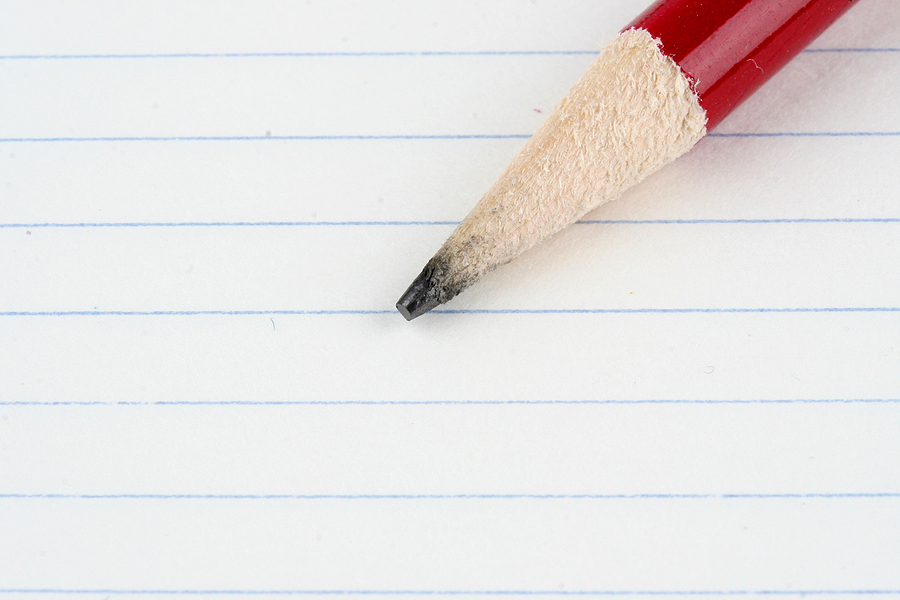
Sharon (not her real name) recently asked me how I get my Literacy students to write on the line. Good question. Mostly it comes down to sheer repetition of the same activities and the same corrections until students get that it’s important to write not just on the line, but between the lines, as well. Not an easy feat.
Tried and True
The obvious way is for students to write in their notebooks, and then the teacher corrects the mistakes. The students then rewrite, following the teacher’s corrections. Another method is to use structured lines. That is, you can use paper with lines and a dotted line between them so that students learn how to shape and size their letters.
I also use handouts with lines provided. It’s important for reinforcement, and practice is one of the most effective ways to achieve it. Lastly, writing by hand helps create muscle memory. Eventually, what at first seemed befuddling — the importance of writing on lines — becomes a habit. It’s ingrained in them through repetition, so they know to write on the line.
Two Different Approaches
Sharon nodded when we discussed the above methods. “Yes, I do them, but still…,” she said. When I mentioned two things that maybe weren’t so obvious, she perked up. She hadn’t thought of them. Here are the two methods I told Sharon about.
First, I use the sign-in book. Students have to sign in when they enter the class. The sheet itself is lined, and in rows, a line for each student. It’s a great teaching tool because students who don’t write on the line can see the signatures of those who do. Just that simple eye test does wonders for their understanding. That’s not to say, however, that it leads to an “aha!” moment and all becomes clear. I still need to point out the difference between signatures. So do the more advanced students.
Another method I employ is using a ruler when students write on the whiteboard. The students who’ve been in class for a while draw the lines when they come to the board. The new students see what the older students are doing. At first, the new students wonder what’s going on. Then they get it. They, too, take the ruler and draw a line to write on. It takes practice, though, for the students to make a straight line, and to keep the ruler firm against the board so that it doesn’t move while they are drawing a line. It usually takes them several attempts, but even then, another student has to come to the board and show them.
Hard Work Pays Off
Writing on the lines is not obvious to Literacy students. Most of them were not taught to do that, even if they went to school. Most Literacy students have little formal education, so classroom culture in Canada is a new experience for them. They have to be taught. While it may seem obvious to us, often it’s not to them. It’s a lot of hard work on the part of both the teacher and the student. When a student does begin to write on the line without a teacher’s help, we all know that all that hard work was worth it.
Image source: www.bigstockphoto.com

2 Comments
This is interesting to know how you build up your students’ habit of writing on the lines, with constant practice. Thanks for sharing! My students face the same problem.
Hi Fakhira,
Thanks for your comment. A task that seems so simple and obvious turns out not to be so. Hope my blog helped.
Derek