
Created with ChatGPT
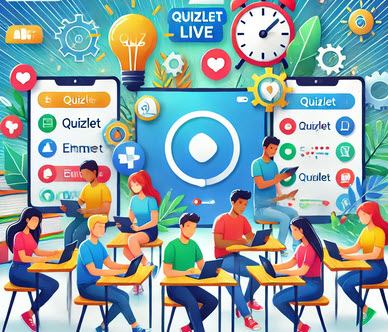
Quizlet Live is the latest feature on the Quizlet suite. This is in addition to current learning activities which include: flashcards, test, learn, spell, as well as two games: gravity and match. In May of 2015 I posted about the attributes of Quizlet from a teacher-developer’s perspective. More recently, I have been working with teachers and students to ensure that Quizlet Live is primarily a game by identifying potential technical issues that can spoil the experience. As the game relies heavily on mobile devices and Wi-Fi internet connection, this was a bit of a challenge. However, we have found that with some experimenting and patience we have created a Teacher’s quick start sheet for you to use if you choose to try Quizlet Live with your students. Feel free to download the quick start sheet from the link below. Here’s why Quizlet is a great tool for your classroom.
Fun Factor
Games, while competitive, can add a fun factor to language lessons. I’ve run more than a dozen Quizlet Live sessions with instructors and students. I can verify that the room livens up and students become active and attentive. Quizlet Live should be used as a review activity. It provides a capstone activity variation for vocabulary lessons that include other Quizlet learning events. As Quizlet offers the inclusion of audio and images, student engagement generally increases. Gamification in controlled and well-timed doses can increase motivation in the classroom. Achieving this balance requires practice and experience, but it’s well worth it when it succeeds.
Quizlet or Kahoot?
Another tool, Kahoot, is often confused with Quizlet Live. They both offer gamification with a primary screen which the teacher controls. Quizlet is primarily a vocabulary acquisition support, while Kahoot can be used as a ‘Swiss Army knife’ for many aspects of language learning. After experiencing both tools, Quizlet Live performs seamlessly once the students have worked with the other Quizlet features. We use Kahoot for targeted learning including grammar, reading comprehension, sequencing, and more.
Overview of a Game
The instructor logs in to their account and locates the study set. A game code is generated and appears on the board or screen at the front of the class. The students navigate to Quizlet.com/live and enter the game code. They are added to a list and wait until all of the students appear on this list. The teacher starts the game process and assigns students randomly to teams or creates custom teams. Custom teams requires a subscribed account.
Once the teams are assigned, students move around the room so that they can see each other’s screens and communicate with each other. Once the teacher clicks the Start Game button students must react to the game prompt and agree on which student submits an answer on their device. This is important as each student has different choices from their peers. Winning the game depends on students cooperating to select a perfect sequence of answers. It is more difficult than you would think, but once they realize that communication and teamwork are the key to success, they become more focused and cooperative.
Considerations when using Quizlet Live
If you have the time, technology and energy to try Quizlet Live, the lists below provide awareness of lessons that we learned while using Quizlet Live with our students.
Easy Stuff
- Quizlet Live is free
- Student accounts are not required to play
- Games can be started by the teacher with any Quizlet study set
- Study sets can include images
- Study sets include audio
- Students are placed into teams or can be assigned by a teacher
- Team names are assigned by Quizlet (animals: Tigers, Parrots, …)
- Communication/negotiation is essential for the teams to make choices
- The game scores are projected from the teacher’s workstation
- Students always request a second and third game (losing team usually)
Challenges
- Six students are required to start a Quizlet Live game
- Each student (or pair) requires a mobile device or workstation
- In the absence of workstations, Wi-Fi is required to run a Quizlet Live game
- Students are normally required to move around the room to form teams
- It can get noisy!
- If a device gets disconnected, the team score can quickly reset to zero
- Notifications on a mobile phone can disrupt the game
- A projector and a teacher workstation are required
- A sense of humour is required
- One wrong team answer resets the team score to zero
If you try Quizlet Live and have something to add, please comment below.
Resources
Allan, John. (May, 2015). Blog Post: CREATE LEARNING OBJECTS QUICKLY WITH QUIZLET. https://blog.teslontario.org/create-learning-objects-quickly-with-quizlet
Sullivan, Nadeen. (October, 2015). Blog Post: USE KAHOOT! TO SPICE UP YOUR LESSONS, https://blog.teslontario.org/use-kahoot-to-spice-up-your-lessons
Quizlet Live Teacher Quick Start sheet http://www.slideshare.net/mrpottz/quizlet-live-teacher-instructions

11 Comments
Thank you for this helpful overview of Quizlet Live. I have used Quizlet games and flashcard sets with my students. We either pull up the game on the projector board or I give them a link on my classroom blog on computer lab day. We do have a school wifi connection and iPads, though getting on and staying on the wifi connection can sometimes be dicey. You’ve given me all the details I need to decide whether to try this with my groups. Thank you!
Kelly, you are welcome. I am glad to help out when I can. I love introducing Quizlet Live to classes or at PD sessions for teachers as the always (fingers crossed) request at least three replays to avenge the other teams. 🙂
I introduced Quizlet to my students three weeks ago as a means of motivating them to learn 10 new vocabulary words per day. Since my 16 adult ESL learners range from upper beginner to early intermediate level, they enjoy adding images to the definitions to create their flashcards and then use the audio feature to practice the pronunciation using headsets. In addition to the flashcards, the spelling and matching activities are very useful in reviewing their new words. Gravity is a challenge for them but they still like to try. Finally, Gravity.Live is their favourite. Each of my students are randomly assigned to a new team by Quizlet. Then the students pick up their portable laptops and move to sit together in teams of four to play the game. They absolutely love it!
Awesome! Quizlet is a great tool for language students. We have recently been embedding links to specific Quizlet activities in our worksheets and in-house student books. I agree that Quizlet Live is a fun and rewarding activity to experience with students. It brings our cooperation and collaboration that may not be normal in a classroom (depending on the class and general circumstances).
Gravity is difficult especially if they are challenged with spelling out the definition which is something that the teacher must be aware of when creating or setting up the activity.
keep up the great work,
John
I just had this published in EFL Magazine. http://eflmagazine.com/quizlet-create-engaging-vocabulary-study-sets/ It might be a useful starting point for those who a novice users of Quizlet.
Quizlet just added a PD page of teacher resources.
https://quizlet.com/help/2725992/article
Quizlet me stand an excellent app because with it you can share educational tokens with your friends or in the classroom. You can also pre-part for the tests while having fun. It is incredible that with this app you can customize your study area with images and audio.<